
As many industries face increasing pressure to operate safely, reduce downtime, and make smarter maintenance decisions, NDT 4.0 is becoming harder to ignore. Combining robotics, digitalisation, real-time data, and automation, NDT 4.0 represents a shift from inspection as a one-off activity to inspection as an intelligent, continuous process.
But awareness and adoption vary dramatically from sector to sector. Some industries are leading the charge. Others are only just beginning to recognise what modern NDT can help them achieve.
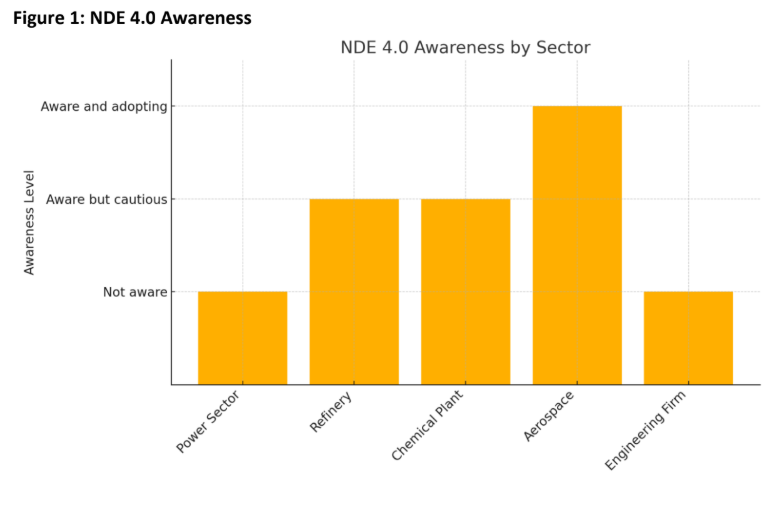
The following graph shows the wide variation in NDT 4.0 awareness across industries, revealing where momentum is building and where significant opportunities for improvement still exist.
This chart was created following a series of interviews with a selection of our contacts.
Power Sector – Are The Benefits Too Big to Miss?
The power sector often lags when it comes to adopting cutting-edge inspection technology. Many plants still rely heavily on manual methods, partly due to ageing assets, legacy processes, and limited downtime windows.
Yet this is precisely why NDT 4.0 matters.
- Robotics can complete boiler, pipework, and confined-space inspections without shutdowns.
- Real-time analytics help operators detect issues long before they become failures.
- Digital traceability supports better planning, compliance, and budgeting.
For a sector under pressure to balance demand, cost, and safety, increasing awareness of NDT 4.0 could unlock major operational and reliability advantages.
Refineries – Cautious About Investment?
Refineries tend to know what NDT 4.0 is, but many hesitate to implement it across the board. Common concerns include:
- Integration with older assets.
- The perception that robotics and digital tools are “disruptive”.
- Investment risk versus proven ROI.
However, early adopters within the refinery world are discovering that the return is significant:
- Shorter inspection windows.
- More accurate data for RBI programmes.
- Less exposure for technicians in hazardous areas.
In a sector where a small defect can mean millions in lost production, the decision isn’t whether NDT 4.0 is worth it, but how soon to adopt it.
Chemical Plants – Cautious and Focused on Safety
Chemical plants share the same cautious mindset as refineries, but their primary hesitation stems from safety and compliance. Leaders want to be certain that digital tools and robotics are robust, reliable, and compliant with stringent operational standards.
Awareness is there, but confidence often isn’t yet.
NDT 4.0 directly addresses these concerns:
- Robotics significantly reduce personnel exposure in high-risk areas.
- Automated UT and guided wave systems provide precise, repeatable results.
- Centralised digital reporting helps demonstrate compliance instantly.
As awareness grows, so does the understanding that NDT 4.0 actually strengthens safety rather than complicating it.
Aerospace – Leading the Way
The aerospace sector is the clearest example of what NDT 4.0 can achieve. High-precision manufacturing, tight regulatory environments, and a culture of technological innovation mean aerospace organisations are already:
- Implementing automated ultrasonic systems.
- Using digital twins to support lifecycle planning.
- Integrating AI-driven defect recognition.
- Transitioning to fully traceable digital inspection workflows.
Their progress demonstrates the competitive edge NDT 4.0 delivers: greater accuracy, improved repeatability, and a step-change in quality assurance.
In many ways, aerospace shows the rest of the industries what’s possible.
Engineering Firms – Becoming More Aware and Quick to See the Value Once Introduced
Smaller or more traditional engineering firms often have limited awareness of NDT 4.0. The misconception is that advanced robotics and digital inspection are “only for large operators”.
Yet once they see NDT 4.0 in action (robotic crawlers, digital radiography, automated reporting) the benefits are immediately clear:
- Faster inspections
- Greater accuracy
- Less disruption to fabrication and production schedules
- Better control of maintenance costs
Awareness might be low, but the potential for rapid adoption is high when the benefits match their operational pressures.
Other Industries Embracing NDT 4.0
Beyond these core sectors, NDT 4.0 is making inroads across oil and gas, nuclear, rail, marine, construction, and renewables. Oil and gas operators are using drones and robotic systems to inspect pipelines, storage tanks, and offshore platforms, reducing downtime and improving safety. Nuclear facilities rely on automated ultrasonic testing and real-time data to maintain highly regulated equipment, while rail and transportation companies are adopting digital imaging and automated inspections to keep tracks and rolling stock in optimal condition. The shipbuilding and marine sector is embracing underwater drones and robotic crawlers for hulls, propellers, and submerged structures, minimising disruption and risk.
Meanwhile, construction and infrastructure sectors are increasingly using sensors, automated scanning, and predictive analytics to monitor bridges, tunnels, and critical structures, helping identify potential issues before they escalate. Renewables, particularly wind and solar, are leveraging drones and robotic systems to inspect turbine blades, towers, and solar panels, improving efficiency and safety. Across these industries, the trend is clear: NDT 4.0 is no longer just a futuristic concept: it is a practical, high-value solution for smarter, faster, and safer inspections.
Why Awareness Matters, and Why It’s Not Enough
Knowing about NDT 4.0 is one thing. Understanding its value is another.
Industries with high awareness (like aerospace) are already benefiting from:
- Reduced downtime
- Higher inspection confidence
- Better workforce safety
- Data-led decision-making
- Improved lifecycle management
Those with low awareness risk falling behind, not just technologically, but competitively. As digital inspection standards evolve, organisations that fail to modernise will eventually face longer shutdowns, higher maintenance costs, and increased compliance pressure.
Take the Next Step with NDT Group
Whether your organisation is just beginning to explore NDT 4.0 or is ready to advance your digital inspection strategy, NDT Group can help you move forward with confidence.
Techniques such as SLOFEC®, in-service tank floor drones, underwater inspection drones, and submersible robotic tank-cleaning drones offer huge potential to improve integrity assessments, reduce downtime, and strengthen safety. These technologies are not just innovative: they are practical, proven tools that deliver richer data, faster inspection cycles, and minimal operational disruption.
At NDT Group, we combine advanced robotics and digital reporting to create safer, faster, data-driven inspection programmes tailored to your assets and industry.
If you want to reduce downtime, enhance safety, and unlock the full value of NDT 4.0, get in touch with NDT Group today. Let’s explore how these technologies can transform your inspection strategy.
